
A buddy of mine who holds elected office has the “hat” theory. As soon as elected officials put on the “hat” of office, it squeezes their heads so tight that they can no longer think. They forget all they knew before, of the wrongs and the remedies, of why somebody decided to vote for them in the first place, and assume the position dictated by the hat. He says they can’t help themselves because it’s the hat.
Archive for April, 2009
Don’t
“It is axiomatic that ‘Judge’ and ‘Stripper’ showing up in a headline is never a good thing, especially if you happen to be the ‘Judge.'” — Daniel Ruth, Tampa Tribune, via Ambrogi, Legal Blog Watch (on disgraced Florida appellate judge Thomas Stringer)(earlier).
Update: Animal rights vs. free speech
The Supreme Court “has agreed to consider whether a law barring videotapes and other depictions of animal cruelty violates the First Amendment.” The law could result in criminal charges being filed over, say, videos of bullfights or cockfights taken in nations where those practices are perfectly lawful, or taken in U.S. states where until recently various forms of animal fighting were lawful. The Third Circuit ruled it an unconstitutional infringement on free speech. [ABA Journal, Lyle Denniston/SCOTUSBlog, Adler @ Volokh; earlier] Nearly ten years ago (yes, believe it or not, this blog will turn 10 as of the first of July) we covered the original federal legislation, and visitors still arrive regularly at this site after searching on the term “crush videos”.
As we noted in a 2006 post, litigators for the Humane Society of the U.S. have been trying to force the U.S. Postal Service to ban the use of the mails by animal-fighting magazines like The Feathered Warrior. Now, according to an HSUS release, they have gotten a judge to order the USPS to reconsider its non-censorship policy. [Rebecca Baker, “Completely Legal” Gannett Westchester legal blog, Apr. 23]
“‘Greedy’ Stanford Law Grad Must Pay $630K in Legal Fees Over Meritless Art Suit”
As the Blog of Legal Times and ABA Journal note, the D.C. Circuit has upheld an order that Washington, D.C. art dealer and attorney Robert Fastov pay more than $630,000 to compensate Christie’s, the auction house, for meritless litigation aimed at extracting a settlement on an untenable claim. In a summary judgment order last year, the trial judge cited Fastov’s “well-documented proclivity in this case to engage in obstructionist litigation tactics” and ordered him to pay fees: “a greedy individual, with the advantage of a legal education and a claimed litigation experience, has initiated and maintained this lawsuit, which anyone with a modicum of common sense would have realized was without merit.”
“After Mom’s Wistful Remark, A Maternity Ward Inquisition”
New mom Karen Piper, groggy with medications, told her doctor she wished the baby had been a girl. And so came to be launched the investigation of whether she was an abuse risk who should not be allowed to take the baby home. (Marc Fisher, Washington Post, Apr. 23).
CPSIA chronicles, April 24
- Understatement alert: per the official Congressional Research Service on Capitol Hill, “For the moment…one thing seems certain: implementation of the CPSIA is not going well.” [report in PDF format courtesy ShopFloor]
- In Wisconsin, the Madison Children’s Museum has for the past 21 years based its annual fundraiser (July 18, this year) on a big discount sale of American Girl dolls and accessories. Worse luck for them.
- “Anti-recycling”, maybe? Is there a word for what happens when you yank perfectly safe, useful products off shelves by the ton and send them instead to landfills?
- Blast from the past dept.: if you think Public Citizen has made a mess of the risk and science issues in its advocacy on behalf of CPSIA, you should check out the world-class mess it made when it enlisted in the trial lawyer campaign against silicone breast implants, to name but such one campaign of many.
- Powersports dealers wary of whether new stay of enforcement really protects them [DealerNews, Sioux City (Iowa) Journal]
- The first senior, influential Senate Democrat to acknowledge that CPSIA needs fixing? Montana’s Max Baucus is willing at least to sign on to a legalize-minibikes bill.
- In the comments section on NPR’s phthalates story earlier this month, one of the most-recommended comments was that by Steven Tesney of Houston, who wrote, “As a result of CPSIA and the surrounding political grandstanding, my small home-based company will be going out of business. I design clothing for ‘Alternative’ families with infants, toddlers & kids. My products are organic and use natural dyes but because of new testing requirements that are completely cost prohibitive, I will be forced – along with hundreds of thousands of crafters, artisans and other small business owners – to close my doors. The only companies that will be able to afford the testing will be large corporations (many from China). Mass produced goods win while homemade, handcrafted goods lose. Say goodbye to the charming hand carved wooden toys & crocheted baby caps that you take to baby showers. Say hello to a plethora of licensed products staring back at your children.”
- “CPSIA and the black market” [Wacky Hermit]
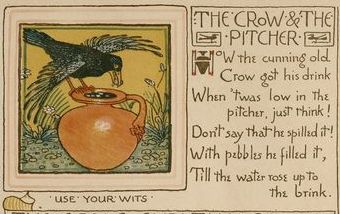
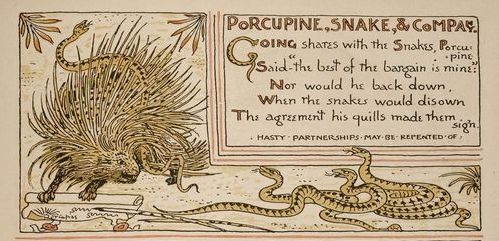
Public domain image courtesy ChildrensLibrary.org: Walter Crane, illustrator, The Baby’s Aesop (1887)
“LIFE IS NUTZ v. LIFE IS GOOD”
“LIFE IS NUTZ seeks declaration that it does not infringe LIFE IS GOOD.” [Marty Schwimmer, Trademark Blog]
Fired for plagiarism, prof now seeks $200 million
Madonna Constantine wants to make Teachers College pay.
Murakami-Vuitton purse art show results in lawsuit
The lawsuit says high-ticket art sold in a boutique at MOCA (L.A.’s Museum of Contemporary Art) was in fact repurposed material from Murakami’s handbag line. Who got fooled by whom in the episode, however, is open to doubt.
Dispute with HOA over unleashed dog walking
$100,000 later, things are getting serious for Robert Wirth Jr. of Tarpon Springs, Fla. [St. Petersburg Times, Consumerist]