
- L.A. County assessor, though in jail, will keep drawing $197K salary plus raise [LAT]
- IRS lowers the regulatory boom on tax preparers [Institute for Justice video, auto-plays]
- On Wal-Mart Mexico bribery, NYT has a bit of a blind eye of its own [Stoll; earlier here, here, etc.]
- Another painful CPSIA regulation: CPSC on testing “representative samples” [Nancy Nord]
- “Popcorn lung” couple “won a $20 million judgment. Now, they’re broke.” [ABC]
- From Todd Zywicki: Libertarianism, Law and Economics, and the Common Law [SSRN via Bainbridge]
- If the courts disapprove of throttling internet speeds, what do they think of throttling class action claims redemption rates? [Ted Frank]
Posts Tagged ‘CPSIA’
Child welfare/protection roundup
- Oh, American Academy of Pediatrics, why are you so consistently wrong? On videogames, on food-ad bans, on guns, CPSIA…
- New book by Annette Fuentes, Lockdown High: When the Schoolhouse Becomes a Jailhouse [John Harris, Guardian]
- There are genuine problems with some countries’ international adoption practices, but should UNICEF really be pushing toward a “leave the kids in orphanages” alternative? [Nick Gillespie on Reason documentary to be released tomorrow]
- At expense of both federalism and religious accommodation, bill entitled “Every Child Deserves a Family Act” (ECDFA) would impose anti-bias rules on state adoption and foster care programs [Washington Blade]
- Cash-for-kids Pennsylvania judge: “Former Luzerne judge Conahan sentenced to 17.5 years” [Times-Tribune, our earlier coverage]
- “Met a guy who works at my old summer camp. Bunks still do raids on other bunks, but their counselors have to file raid forms first. How sad.” [@adamlisberg]
- Sex offender registry horror story #14,283 [Skenazy]
- “Safety rules rob pupils of hands-on science, say MPs” [Independent, U.K.]
- Gee, who could’ve predicted that? NJ’s aggressive “anti-bullying” law leads to new problems [NYT, Greenfield, PoL, NJLRA] Rapid growth in bullying law assisted by push from Obama administration [WSJ Law Blog, Kenneth Marcus/Federalist Society, Bader]
September 12 roundup
- Ninth Circuit: Holland America cruise line not responsible for customer’s swimming mishap at Mexican beach [Metropolitan News-Enterprise]
- “President Perry would mean high noon for trial lawyers” [Kurt Schlichter, Washington Examiner; Politico; Prof. Bainbridge (“If the trial lawyers hate Rick Perry, maybe I should reconsider him”)] Christie praises Perry’s “laudable” record on liability reform [PolitickerNJ] “Perry’s ‘loser pays’ is an economic winner” [Patrick Gleason and Jason Russell, Washington Times; Mass Tort Prof; background] Missing the point on the Texas med-mal experience [Coyote, earlier here, here, etc.] A bad sign: Gov. Perry reaches out to Maricopa County sheriff Joe Arpaio [NRO, background] Another: courting social conservative vote, he pledges interference in state marriage law [Houston Chronicle]
- Alan Lange and Tom Dawson discuss their Dickie Scruggs book [Above the Law, background]
- Hospital pays $25M to settle lawsuit charging lack of Katrina preparedness [White Coat]
- Democratic majority on CPSC plans to ram through burdensome CPSIA testing and certification rule next month [Commissioner Nancy Nord, more]
- For matching willing buyers with sellers through Canadian pharmacy ads, Google agrees to pay fine of $500 million, a forfeiture geared to the revenue the pharmacies (not it) took in from the ads [Atlantic Wire, Chris Fountain]
- “Woman Won’t Have to Pay for Her Own Cavity Search” [Lowering the Bar]
More CPSIA overkill: lowering lead limits
By a 3-2 party line vote, the Consumer Product Safety Commission has voted to lower already infinitesimal thresholds of lead permitted in children’s products to 100 parts per million. The main impact will not be on surface paints or other flakable/chewable hazards to the youngest users, but on “substrate” elements such as metal alloys employed in such objects as bicycle parts, school binders, and ballpoint pens, an even wider swath of which will be hard to sell or resell without breaking the law. [Bloomberg; commissioners Nord, Northup; Woldenberg, more and yet more]
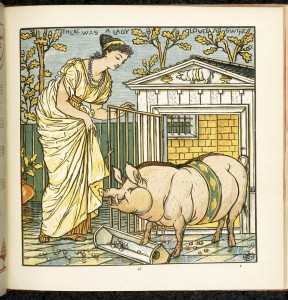
PUBLIC DOMAIN IMAGE from Walter Crane, The Baby’s Opera (1876), courtesy BabylonBaroque.
Bungling nanny trashes 100,000 cribs
Around the country today, CPSC regulations are forcing retailers to throw out new, unused baby cribs — estimates of the number range higher than 100,000 — that the federal government itself considers safe enough to be used in day cares. I explain the latest Nanny State snafu in a new post at Cato at Liberty.
More: Quin Hillyer, CFIF; Katherine Mangu-Ward, Reason. And CPSC commissioner Anne Northup corrects a misimpression in some parts of the press:
The new standards ban drop-side cribs. But the standards also prohibit the sale, new or used, of all cribs – both drop-side and fixed-side – that are not tested to the new standards by a private laboratory. Because very few cribs that were not originally manufactured to the new standards will ever be tested, the new standards essentially ban all such cribs – drop-side and fixed side. As reported in today’s press, millions of drop-side cribs have been recalled. On the other hand, tens of millions of fixed side cribs manufactured to previous standards have never been recalled, never been found to be unsafe, and now also cannot be sold new or resold used.
May 27 roundup
- Prospects dicey at best for CPSIA reform as Waxman, Dems toe consumer-group line [Woldenberg, more, Nord, Northup] If AAP is going to posit 49,000 poisonings from lead in recalled jewelry, shouldn’t it try to document a couple of them? [Woldenberg] Credit at least to House Commerce Committee majority for trying to tackle mess with this law [Mangu-Ward, ShopFloor, AtC]
- “Lawsuit claims Jay-Z’s ‘Big Pimpin’ violates Egyptian ‘moral rights'” [DBR]
- My Cato Institute colleague Gene Healy reviews new Eric Posner/Adrian Vermeule book on executive power [AmCon]
- Subpoena filed by class-action lawyer Stephen Tillery demands contributor list of Chicago-based think tank critical of litigation [Madison County Record] Judge quashes subpoena as chilling of First Amendment liberties [same]
- Suits filed by its own officers, often those accused of misconduct, have cost LAPD $18 million since 2005 [L.A. Times via Dave Krueger, Agitator]
- “Do Menthol Cigarettes Taste Too Good to Be Legal?” [Sullum, earlier]
- “Motion Claims Buxom Woman with Opposing Counsel Is Intended as Jury Distraction” [ABA Journal] More: Ken at Popehat, Lowering The Bar, Above the Law.
CPSIA: “Toymakers Would Get Relief Under Republican Plan”
Reform efforts are finally afoot in the House of Representatives, at least two years after they should have started, but a three-member majority of the CPSC (two Obama appointees and a holdover) is defending the law on many though not all of its worst points. [Bloomberg, HuffPo] “This is by far the best bill we’ve seen to date,” declares the Handmade Toy Alliance. Tireless CPSIA critic Rick Woldenberg testified with other witnesses at a House Commerce hearing and contributes an op-ed to The Hill about the law’s irrationality. More coverage: Carter Wood/ShopFloor, Sean Wajert. And a memo by committee staff discussing some of the key issues is here (PDF).
Mothering Magazine ceases print publication
And one of the reasons for the title’s closure after 35 years might be surprising, at least to non-readers of this site. [Handmade Toy Alliance]
“I’m no longer comfortable posting publicly about CPSIA…”
A thrift store owner explains why. [Rick Woldenberg] More: Timothy Carney, Examiner.
Do NYT editorialists even read their paper’s own CPSIA coverage?
The New York Times editorial page continues to dismiss criticism of the testing burdens of the Consumer Product Safety Improvement Act of 2008 on small manufacturers and retailers as “part of a standard antiregulation litany.” But on October 30, 2009 the paper itself ran a sadly belated but otherwise decently executed article  by reporter Leslie Wayne from which a fair-minded reader would conclude that the small makers’ complaints about the law are only too well-grounded (“Burden of Safety Law Imperils Small Toymakers.”)
If one were to take a charitable view, one might commend the Times editorialists for at last deigning to concede that the law might usefully be “tweaked,” at least within a very narrow latitude. They finally acknowledge that there “might be a way to exempt products from testing if they very clearly do not pose a lead-related hazard,” without acknowledging that the great majority of products swept under the law’s coverage fall into exactly such a category. But they continue to insist that even older kids be denied access to products that could not pass  CPSIA’s lead testing, including whole categories of products like kids’ bicycles and ballpoint pens whose designs still cannot dispense with the (entirely harmless) use of brass and suchlike alloys. Only the repeated staying or postponed enforcement of many of the law’s requirements has spared the country a long list of similar absurdities — while the legal absurdities that the CPSC has not stayed or postponed have already wiped out makers and vendors of harmless products from coast to coast.
Even under the best of circumstances, the Times’s editorialists would find it hard to live down their cruel, ideologically blinkered track record on the CPSIA issue. But couldn’t they at least pretend to be following the coverage in their own paper? More: Handmade Toy Alliance. And Rick Woldenberg offers a critique of the the Times’s new, and anything but improved, news-side reporting.