
- Presumptive ban on homeschooling? A bad idea for so many reasons, especially when the presumption should be of liberty [Erin O’Donnell, Harvard Magazine; Kerry McDonald, Cato] Harvard Law School is hosting a June conference on homeschooling and the law dominated by advocates of placing new legal restrictions on the practice [Corey DeAngelis] A recent HLS grad who was homeschooled weighs in [Alex J. Harris]
- Equity versus achievement: U.S. Department of Education urges schools working remotely to teach new content rather than just review the old [Andrew Ujifusa, Education Week, earlier on controversy; Hans Bader on Arlington, Va. schools]
- “A politically progressive caucus within the [teacher’s] union is calling on its leaders to push for ‘less academic work’ during the coming months, and to lobby for a moratorium on student grades and teacher evaluations.” [Dana Goldstein and Eliza Shapiro, New York Times] San Francisco school board to vote on plan that would give students in grades 6-12 a grade of A in all subjects [KGO; Alison Collins and commenters; related on mass social promotion, Andy Smarick, The Atlantic]
- Those copyright license issues that keep church congregations from incorporating music into their online services also complicate the lives of educators trying to carry out online instruction [Mike Masnick, TechDirt]
- Before, or at least separate from, the crisis: “Should Students Be Excused from School for Political Activism?” [Jim Geraghty, National Review] “Public Education as Public Indoctrination” [Ilya Somin] Group that wants regulatory stringency of federal school lunch program to be decided in courtroom rather than at ballot box ironically styles itself “Democracy Forward.” [Lola Fadulu, New York Times]
- Split Sixth Circuit panel rules that Due Process Clause of the Fourteenth Amendment protects a fundamental right to a “basic minimum education,” a holding that seems unlikely to survive Supreme Court review given such precedents as Rodriguez, Glucksberg, and DeShaney [Jonathan Adler, Josh Blackman]
Posts Tagged ‘disability & schools’
Disabled advocates: no teaching new content to at-home students
Some disabled rights advocates say until schools can adapt online lessons to assist every special ed kid, schools should not be allowed to use remote learning to finish this year’s curriculum. Fortunately, Education Secretary Betsy DeVos said no to that bit of zealotry — even if it did carry the day in school systems like Chicago’s. My new Cato post argues that the advancement of the student body as a whole should not be held hostage to anti-discrimination principles.
ADA and disabled rights roundup
- I’ve expanded the previous post in this space on Braille gift cards into a longer Cato post with a bit more on the politics and history of the ADA (Americans with Disabilities Act), mentioning along the way the recent closure of a popular San Jose coffee shop [Nadia Lopez, San Jose Spotlight; another San Jose deli story] Speaking of such happenings, “He says the suit could mean the end of the restaurant. ‘We would rather just close down if we have to pay that absurd amount of money,’ he says.” [Rancho Vegano in New York City’s East Harlem neighborhood; Michael Scotto, NY1 Spectrum News]
- “It’s about time! New rule could have emotional support animals bumped from planes” [Lynn Norment, Memphis Commercial Appeal; Wes Siler, Outside; David Koenig, AP]
- Videos on leading pornographic websites “lack enough closed captioning, claims the class-action lawsuit filed on behalf of all deaf and hard-of-hearing people.” [Noah Goldberg, New York Daily News]
- “Federal Website Access Lawsuit Numbers Increase 7 Percent in 2019, With Possible Bump from Supreme Court Denial of Cert in Domino’s” [Kristina M. Launey and Minh N. Vu, Seyfarth Shaw; Vu on related litigation trends in 2019]
- “White students in New York City are 10 times as likely as Asian students to have a 504 designation that allows extra time on the specialized high school entrance exams.” [Kevin Quealy and Eliza Shapiro, New York Times; Dana Goldstein and Jugal K. Patel, New York Times (“it helps to have cash” in getting pricey psychological assessments in Southern California); Education Next (“number of high school students being given special allowances for test-taking, such as extra time, has surged in recent years” with students in affluent suburbs more likely to get them)]
- “Law firms settle suit accusing them of civil RICO conspiracy to collect ADA settlements” [Debra Cassens Weiss, ABA Journal; Moore and Mission law firms, California; KGO/ABC7News on some Bay Area cases]
Destructive rights of student inclusion
If you have wondered how the Parkland killer could have asserted a legal right to be “mainstreamed” into Marjory Stoneman Douglas High School despite a long history of violent tendencies, this investigation by the local newspaper may provide your answer.
In an eight-month investigation, the South Florida Sun Sentinel found that a sweeping push for “inclusion” enables unstable children to attend regular classes even though school districts severely lack the support staff to manage them. … Even threatening to shoot classmates is not a lawful reason to expel the child….
“It’s just a no-win scenario right now,” said attorney Julie Weatherly, of Mobile, Alabama, who advises school districts on the legal complexities of removing aggressive students when they have a disability. “Nobody wants a Parkland, of course. It’s this huge nightmare.”
Aside from IDEA, the federal disabled-rights-in-school laws, and its sometimes even more stringent state counterparts, federal education privacy laws are involved as well. A Broward County teacher chose to break the rules after an elementary student “obsessed” over a girl, tormented her if she withheld attention, and on being removed from the classroom one day cried and screamed her name while throwing himself against a door:
The girl’s mother had no idea her daughter was being terrorized. Because of the student’s federally protected privacy rights, Budrewicz’s bosses cautioned her not to tell the mother — a warning she ultimately defied. The mom cried and thanked her and removed her daughter from the class the next day, she said.
[Brittany Wallman and Megan O’Matz, South Florida Sun-Sentinel; earlier here and here]
Schools and childhood roundup
- Stop active-shooter drills in schools: “Preparing our children for profoundly unlikely events would be one thing if that preparation had no downside. But in this case, our efforts may exact a high price.” [Erika Christakis, The Atlantic] “Lockdowns and active-shooter drills have led to officers firing blank rounds to simulate live fire, mock executions of teachers, and students tearfully writing out wills while hunkered down. …Last year, The Post reported an estimate that the odds of a child being fatally shot while at school any given day since 1999 was 1 in 614,000,000.” [Jonathan Blanks, Washington Post/Cato]
- After ordeal with Child Protective Services based on drug test fluke, Western New York mom “is certain of one thing, she’ll never eat a poppy seed again.” [WROC]
- Answer: no. “Should access to a public education be a constitutional right for all children?” [Jessica Campisi, Education Dive; Mark Walsh, Education Week, covering AEI debate on holding of 1973 Supreme Court case of San Antonio Independent School District v. Rodriguez against such a federal right]
- Pay attention to the politics of schools of education, because they help determine what you’ll see in the classroom down the road [Jay Schalin, Martin Center] More: University of Washington’s Secondary Teacher Education Program “is a 12-month immersion in doctrinaire social justice activism.” [Quillette]
- “The Regressive Effects of Childcare Regulations” [Cato video with Ryan Bourne]
- “Court revives Obama-era rule that incentivizes racial quotas in special ed” [Liam Bissainthe]
College admissions scandal: “most of these kids don’t even have issues, but they’re getting time.”
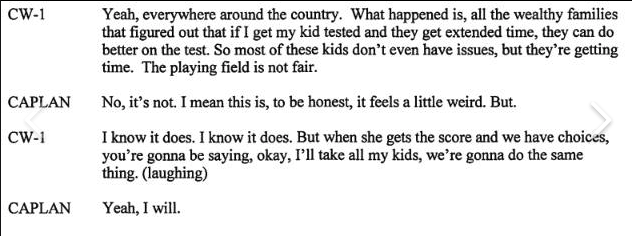
For 20 years I’ve been writing about how the gaming of disability diagnoses in schools helps affluent families. And I was hardly alone: in 2004 Craig Lerner wrote a paper entitled: “‘Accommodations’ for the Learning Disabled: A Level Playing Field or Affirmative Action for Elites?” There hasn’t been much interest in fixing things.
Now test accommodations have surfaced as one key theme in the big and colorful new college-admissions scandal. “Particularly glaring in the 204-page indictment is that the majority of the children, whose parents were charged Tuesday, had seamlessly secured disability accommodations on their standardized tests. This enabled them to have additional time on the exams and to take them alone with the proctor at a private testing facility that was located, in some cases, thousands of miles from the test-takers’ residences.” [Michelle Robertson, SFGate/New Haven Register] More: Akira Olivia Kumamoto, Sacramento Bee; FBI affidavit on new scandal; Doree Lewak, New York Post last year on accommodations.
Higher education roundup
- Administrators at University of Southern Maine, a public institution, hastily yank course that offered credit for harassing Sen. Susan Collins on Kavanaugh nomination [Dennis Hoey, Portland Press Herald, USM press release] Some colleges would rally around an alumnus nominated to the high court, while others would maintain institutional neutrality. At Yale a large faction demanded a commitment to opposition [Peter Schuck, Minding the Campus; related Twitter thread (“2018: the year of weaponizing college friendships”)]
- Canadian university suspends economics professor without pay for publishing journal article documenting colleagues’ publication in questionable scholarly journals [Douglas Todd/Vancouver Sun, paper]
- Q. How many lampooned academics does it take to appreciate the Helen Pluckrose / James Lindsay / Peter Boghossian grievance studies hoax? A. That is *not* funny [Alexander C. Kafka, Chronicle of Higher Education rounding up reactions]
- Notwithstanding “enforcement will be consistent with the First Amendment” disclaimer, language in U.S. Dept. of Education Office for Civil Rights ruling could pressure universities to restrict some criticism of Israel [Eugene Volokh]
- “As many as one in three students at some elite colleges have been officially designated ‘disabled.'” [Garland Tucker, Martin Center] “ADA in the Classroom: Suitable Accommodation or Legalized Cheating?” [Ari Trachtenberg, 2016]
- “Taking the Bar Exam as a 46-Year-Old Law Professor” [Orin Kerr]
Higher education roundup
- New York Times tackles a story of lopsided Title IX process [Michael Powell, NYT on Keith Mumphery Michigan State case] Federal court spanks Johnson & Wales in Rhode Island over kangaroo court [KC Johnson, Minding the Campus] U.S. Department of Justice “has filed a statement of interest in a lawsuit challenging the University of Michigan’s controversial speech code policies” [Nikita Vladimirov, Campus Reform]
- “Judges,” he told the crowd, “cannot be intimidated,” and “Lawsuits are won and lost in the courtrooms, not in the streets.” Gail Heriot gives Stanley Mosk his due;
- Suing for faculty positions: “While I find it regrettable that university faculties are so politicized that good candidates like Teresa Manning get rejected, I think it would be even worse to have some law or regulation against discrimination based on politics.” [George Leef]
- “As many as one in four students at some elite U.S. colleges are now classified as disabled, largely because of mental-health issues such as depression or anxiety, entitling them to a widening array of special accommodations like longer time to take exams” [Douglas Belkin, WSJ]
- Diversity follies in STEM [Heather Mac Donald, City Journal] University of Michigan employs 93 full-time diversity staffers [Mark Perry]
- “Six Ideas to De-Politicize the American Campus” [Martin Center]
Schools roundup
- “Wyoming: Efforts to strip state courts of jurisdiction to hear K-12 funding lawsuits reintroduced; courts could declare funding system unconstitutional but could not order more funding” [Gavel To Gavel, more on school finance litigation]
- Coalition of accusers’-rights groups sue Education Department demanding restoration of earlier Obama versions Title IX guidance [KC Johnson Twitter thread pointing out weaknesses in suit]
- “A High School Student Faces Expulsion for Noticing the Square Root Symbol Looks Like a Gun” [Scott Shackford]
- How a political machine based on the schools lobby ran one affluent suburban county (Montgomery County, Maryland) before fumbling its grip [Adam Pagnucco, The Seventh State]
- Costs approach $1M in Southern California special ed dispute over one student’s education [Ashly McGlone, San Diego Union-Tribune]
- Japan: “Of course, this ignores the absurdity that students are being required, or feel required, to dye their hair because of a policy that was supposedly meant to prohibit students from dying their hair.” [Lowering the Bar]
Florida shooter had been chronic disciplinary problem. “Could school system have done more?”
Amid horrendous misbehavior attributed to his emotional and behavioral disabilities, the future shooter was shuttled among various Broward County schools, including an episode being “mainstreamed” at Marjory Stoneman Douglas HS, scene of his later atrocity. Under the U.S. Rehabilitation Act of 1973, which has been intensively litigated over the years, “school districts are required to provide kids with physical, emotional or intellectual disabilities a free education in the ‘least restrictive’ setting, and to accommodate the needs of such students.” [Carol Marbin Miller and Kyra Gurney, Miami Herald] He “was well-known to school and mental health authorities and was entrenched in the process for getting students help rather than referring them to law enforcement….Beginning in 2013, Broward stopped referring students to police for about a dozen infractions ranging from alcohol and drug use to bullying, harassment and assault,” under influence of national campaign against “school-to-prison pipeline.” [Tim Craig, Emma Brown, Sarah Larimer and Moriah Balingit, Washington Post]