
The Godiva chocolate company puts “Belgium 1926” on many of its labels and promotional materials, referring to its origins nearly a century ago in Brussels. “Kevin Fahey, of Virginia, argued in a lawsuit filed in D.C. this week that Godiva commits ‘massive fraud’ by suggesting on product labeling and their website that their products are Belgian…. ‘It is important to emphasize that “Belgium 1926” signifies the place and year of the company’s founding. It does not imply that a product purchased today was made in Belgium nearly one hundred years ago,’ the company said in a statement.” A similar lawsuit was dismissed earlier in California. [Andrea Swalec, NBC Washington; Scott MacFarlane]
Posts Tagged ‘eat drink and be merry’
April 3 roundup
- “Arkansas Passes Bill to Prevent Sale of ‘Cauliflower Rice'” [Bettina Makalintal, Vice via Anthony M. Kreis (“Carolene Products of our time”, and more on that celebrated filled-milk case]
- Ted Frank has another case raising the cy pres issues the Supreme Court just sidestepped in Frank v. Gaos [Marcia Coyle on rewards-program class action settlement in Perryman v. Romero]
- Feds recommend 12 year sentence for copyright and ADA troll Paul Hansmeier [Tim Cushing, TechDirt]
- Didn’t realize New York City still had such a substantial fur industry – much of it in the district of an elected official who’s keen to ban it [Carl Campanile, New York Post]
- “Who’s Afraid of Big Tech?” Cato conference with Matthew Feeney, Alec Stapp, Jonathan Rauch, Julian Sanchez, Peter Van Doren, and John Samples, among many others [panels one (“Big Brother in Big Tech”), two (“Is Big Tech Too Big?”), three (“Free Speech in an Age of Social Media”)]
- Looking forward to this one, due out from New York lawyer James Zirin in September: Plaintiff in Chief: A Portrait of Donald Trump in 3,500 Lawsuits [St. Martin’s Press]
Food and paternalism roundup
- “Sandwiches and main meal salads will be capped at 550 calories, ready meals will be capped at 544 calories and main courses in restaurants will be capped at 951 calories.” Guidelines from Public Health England aren’t mandatory yet, but expect U.K. government pressure on supermarkets and restaurants [Christopher Snowdon, Baylen Linnekin, Scott Shackford, Ryan Bourne]
- “We are not saying they can never give children a chocolate or biscuit ever again,” says the Public Health England official. “But it cannot be a daily occurrence.” And more from “2018: The [mostly U.K.] nanny state year in review” [Snowdon]
- Research paper on Philadelphia soda tax: cross-border shopping completely offsets in-city reduction in beverage sales, “no significant reduction in calorie and sugar intake.” [Stephan Seiler, Anna Tuchman, and Song Yao, SSRN via Caron/TaxProf] More: owner blames tax for closure of Philly supermarket [Eric Boehm]
- Alternative headline: feds act to curb food waste by giving local schools more freedom to offer lunches kids will willingly eat [Jaden Urbi, CNBC]
- “Los Angeles councilmember Paul Koretz [has] introduced a bill that, if passed, would require entertainment and travel venues around town to put at least one vegan dish on their menus.” [Clint Rainey, Grub Street; Scott Shackford]
- “Dollar stores are the latest target of advocates who want to improve food offerings by limiting them” [Baylen Linnekin]
California moves to curb slack-fill litigation
We’ve posted often about lawyer-driven slack-fill lawsuits, in which class action filers claim that food, cosmetic, and other products sold by weight have excessive empty space in their packaging. (Laws governing food packaging allow for empty space that serves a function such as protecting the product from damage or shoplifting, but there is room for much disagreement on what is or is not needed for functionality.) The suits’ outcomes can seem random if not whimsical: Ferrara Candy recently agreed to pay $2.5 million to settle claims [Douglas Yu, Confectionery News] while the makers of Fannie May and Junior Mints successfully obtained dismissal of suits against them in federal courts [Scott Holland, Cook County Record; Bloomberg]
California has been a hotspot of slack-fill litigation, but now the California legislature has passed a bill, signed into law by Gov. Jerry Brown in September, expanding the list of safe-harbor defenses that manufacturers (prospectively, in future suits) can assert against slack-fill claims. While the changes are limited in scope and will still allow many suits to go forward, it is noteworthy for California’s legislature to take even symbolic steps against the state’s busy class action industry. [Sarah L. Brew, Tyler A. Young, Emily R. Bodtke and Rita Mansuryan, The Recorder; Robert Niemann and Jill Mahoney, Washington Legal Foundation]
Patented meat cuts
Not a new story, but new to me: Oklahoma State University says it has been awarded patent as well as trademark protection on what is called the Vegas Strip Steak, a part of the cow previously consigned to ground beef and other humble uses. [John Klein, Tulsa World last October; Drovers, John Ewoldt, Minneapolis Star-Tribune in 2012]
Kal Raustiala and Chris Sprigman wrote at Freakonomics in 2012:
There’s no way OSU could patent the steak itself. The steak is just a piece of a cow. It is, in other words, a product of nature, which cannot be patented.
Wisely, OSU’s patent apparently isn’t on the steak itself, but on the knife cuts necessary to extract the steak. But that approach is dubious as well. Once you know where the steak is, the cuts necessary to get at it may be obvious to a skilled butcher. Things that are obvious cannot be patented.
The Patent and Trademark Office presumably accepted the methods for producing the cut as other than obvious. More on patented meat items from Article One Partners.
June 20 roundup
- “Egregious” conduct: Fourth Circuit upholds $150,000 sanctions against attorneys who “challenged the authenticity of a loan agreement for two years before revealing that they possessed an identical copy, obtained from their client, before filing the complaint.” [Six v. Generations Federal Credit Union]
- Food bill: Congress seems intent on not letting the public find out how well grocers do from the SNAP program [Jonathan Ellis, USA Today]
- “Why Trump’s Higher Tariffs Now are Unlikely to Result in Lower Tariffs Later” [Coyote]
- After 10 years, Nathan Myhrvold’s patent assertion fund idea hasn’t done so well [Nathan Vardi, Forbes]
- Potential of “cottage food” laws remains unrealized [Baylen Linnekin]
- Why noted regulation critic David Schoenbrod is also critical of the regulatory reform proposal known as REINS [Philip Wallach, Real Clear Policy]
Legal muscle at last for kids’ lemonade stands
Yes, this is a marketing campaign, but oh what a marketing campaign: makers of Country Time lemonade pledge funding to pay the fines and legal fees of kids busted for setting up lemonade stands.
Kids across the country are getting busted for operating lemonade stands without a permit. We're taking the lead to #SaveLemonadeStands by paying for kids' fines + permits this year. For every RT this gets we’ll donate $1 (up to $500,000) to help kids next year + beyond.
— CountryTime (@CountryTime) June 7, 2018
Our earlier coverage of stands’ legal hassles is here, here, here, here, and here. You can visit the campaign site here and view the video here.
Wisconsin’s butter-grading scheme
Wisconsin, where dairy producers hold great political sway, maintains a uniquely onerous scheme of butter grading that “has nothing to do with public health or nutrition” but does serve to restrict the sale of butter made in other states, including high-end artisanal butter. Representing Ohio’s Minerva Dairy, the Pacific Legal Foundation has sued to overturn the regulation on Commerce Clause, Due Process, and Equal Protection theories, and Cato has now filed a pun-strewn amicus supporting the due process and equal protection claims [Ilya Shapiro and Matt Larosiere]
April 25 roundup
- New suits claim lack of web accessibility features in online employment applications violates California’s ADA equivalent law [Kristina M. Launey & Myra Villamor, Seyfarth Shaw]
- Sugar in candy? Who knew? [John O’Brien and John Breslin, Legal Newsline/Forbes] Slack-fill lawsuits reveal nonfunctional void within class-action industry [Baylen Linnekin]
- Musical instruments in court: the stories behind six famous gear disputes [Jay Laughton, Reverb last year]
- “Secret of David Copperfield’s signature trick revealed in slip-and-fall suit by audience volunteer” [ABA Journal]
- Given Congressional presence in area, California not entitled to use foie gras regulation to impose its views of duck and goose husbandry on producers outside state [Ilya Shapiro and Reilly Stephens on Cato cert amicus in Association des Eleveurs de Canards et d’Oies du Quebec v. Becerra]
- “The earliest versions of the “People’s Court” TV show used law professors as the judges. They were picked because they were articulate and looked like judges but weren’t state bar members; for bar members, being on the show was seen as unlawful advertising.” [@OrinKerr linking Roger M. Grace, Metropolitan News-Enterprise in 2003]
Uneeda Biscuit vs. Iwanta Biscuit
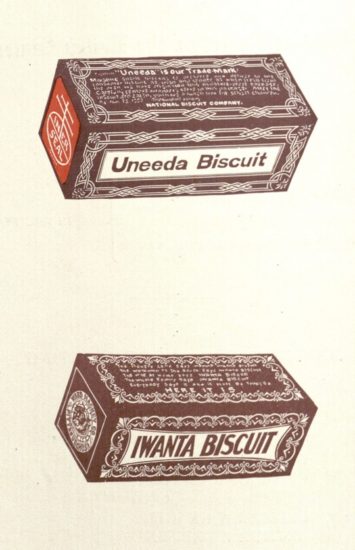
— From a series of illustrations and photographs used as evidence in litigation, part of an exhibition (“Law’s Picture Books”) at NYC’s Grolier Club of more than 140 items from the Yale Law Library’s collection of images and writings on legal themes. The case of the rival cookie boxes resulted in a court’s finding in 1899 that the National Biscuit Co., maker of Uneeda, was entitled to an injunction.