
Thanks to Daniel Takash of Captured Economy for this one: “Some good news emerging from silly litigation: Solid Oak Sketches, which holds the rights to several tattoos featured on NBA players (yes, you can copyright a tattoo) failed in its suit against 2K games for the depictions of the tattoos in the NBA 2K games. The court found that the use of the designs was not infringing because the use of the work in the video game was transformative, the degree of copying was not substantial, and that the game makers had a non-exclusive (albeit non-implied) license to the use of the tattoos when they were using the likeness of the NBA players depicted.”
Posts Tagged ‘sports’
“He told a kid to slide. Then he got sued.”
Junior varsity baseball player in New Jersey “suffered a brutal ankle injury on a slide, and his family sued the coach who told him to do it.” The seven-year legal battle that resulted “threatened to change youth sports forever.” [Steve Politi, NJ.com via Peter Bonilla]
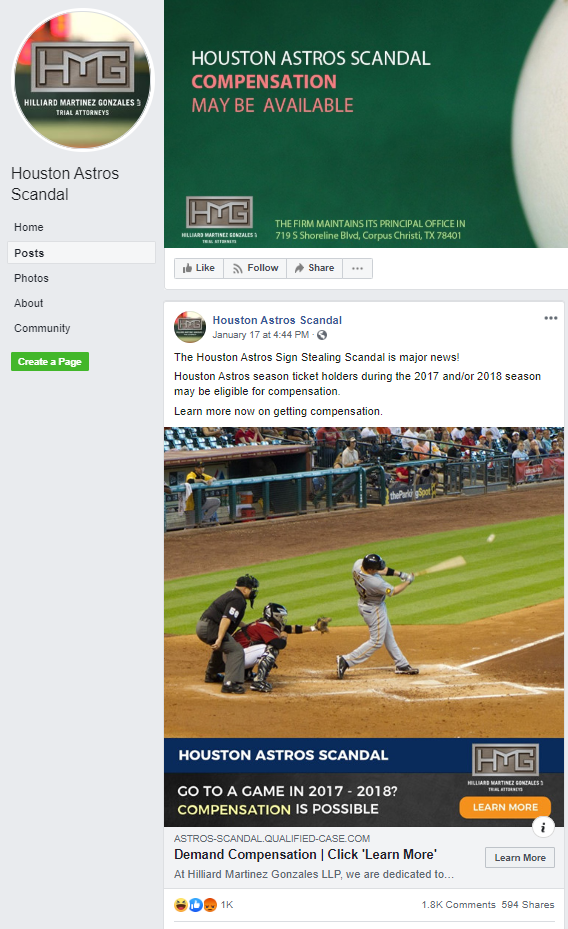
“Houston Astros Scandal — Compensation May Be Available”
This is precious:
October 30 roundup
- Under investigation and facing the same sorts of tactics he once used against Wall Street, Giuliani may now have reason to appreciate the sorts of principled civil libertarians who stand firm against prosecutorial excess [Ira Stoll]
- U.S. dominance in social media is the envy of the rest of the world. Politicians’ trustbusting zeal could change that [Amy-Xiaoshi DePaola, Cronkite News/Arizona PBS, thanks for quoting me]
- Walgreen’s had a tussle with Wegman’s over the trademark use of a big script “W,” but has not gone after with another well-known organization with such a letter symbol, the Washington Nationals [Richard Patterson, American University IP Brief back in 2011]
- British Columbia human rights tribunal rejects groin-waxing complaint, finding that complainant “engaged in improper conduct”, “filed complaints for improper purposes”, and gave testimony that was “disingenuous and self-serving,” along with having “targeted small businesses, manufactured the conditions for a human rights complaint, and then leveraged that complaint to pursue a financial settlement from parties who were unsophisticated and unlikely to mount a proper defense.” [Joseph Brean, National Post, Justice Centre, opinion in Yaniv v. Various Waxing Salons (No. 2), earlier]
- “University of Louisville Students Can’t Sue Escort for Exposing Prostitution in the Louisville Basketball Program” [Eugene Volokh]
- Intending no disrespect, Your Honor, you should think twice before doing this [Zachary Halaschak, Washington Examiner (“Two male judges shot after female judge gives middle finger during drunken night out”; Indiana)]
Liability roundup
- “TriMet faulted Laing for failing to heed warning signs … and earbuds playing loud music. Laing’s attorneys argued it couldn’t be determined what volume the music was playing at at the time of impact.” [Aimee Green, Oregonian; $15 million jury verdict for woman who dashed in front of train reduced to $682,800]
- “When Are Athletes Liable for Injuries They Cause?” [Eugene Volokh on Nixon v. Clay, Utah Supreme Court]
- Former Alabama Sen. Luther Strange has written a law review article on local government abuse of public nuisance law in industrywide litigation [Stephen McConnell, Drug and Device Law] “California’s disturbing lead paint ruling is going interstate. Magistrate cites it in opioid MDL to support tribal nuisance claims under Montana law” [Daniel D. Fisher on Blackfeet Tribe v. Amerisource] Federal judge should have said no to Rhode Island climate change/public nuisance suit [Michael Krauss, Forbes]
- “Will New York law change veterinary malpractice?” [Christopher J. Allen, Veterinary News]
- Supreme Court’s 5-4 ruling on class action counterclaim removal in Home Depot U.S.A. v. Jackson leaves Congress to fix what Judge Paul Niemeyer called a loophole in the Class Action Fairness Act [Diane Flannery, Trent Taylor & Drew Gann, McGuireWoods, Federalist Society teleforum with Ted Frank]
- In Missouri, logjam for liability reform breaks at last as Gov. Mike Parson signs four pieces of legislation into law [Daily Star Journal (Warrensburg, Mo.); Beck on forum-shopping measure]
Higher education roundup
- Harvard lawprof Ronald Sullivan Jr. driven from post as faculty dean of a residential house at the university after student protests of his representation of Harvey Weinstein [Jeannie Suk Gersen, New Yorker; Dianna Bell, WBUR; and for a different perspective Tyler Cowen] Stuart Taylor, Jr. has some questions about Harvard’s investigation, on charges of sexual misconduct, of noted economist Roland G. Fryer Jr. [Real Clear Investigations] 30 protesters rush the stage, ending Harvard President Lawrence Bacow’s speech: “The heckler’s veto has no place” [Robby Soave, Reason]
- Rules mandating gender quotas in hiring committees at French universities may have backfired, as “committees affected by the quota were significantly less likely to hire women” [Chris Woolston, Nature]
- Maryland lawmaker proposes collective bargaining for student athletes [Bruce DePuyt, Maryland Matters]
- “…and suggested that Plaintiff obtain an expensive genetic test to see if she could qualify as Native American or American Indian to garner better chances of being accepted to” the professional school [John S. Rosenberg, Minding the Campus] Families of wealth and standing have special reason to dislike standardized testing. But they’re quite good at dressing up their resentments as progressive [Daniel Friedman, Quillette]
- “Does Yale Law School’s Antidiscrimination Policy on Subsidies for Student Employment Discriminate on the Basis of Religion? [Ilya Somin, who concludes that it doesn’t]
- This year, as every year, checking the line-up of commencement speakers provides a handy way to size up the Forces of Unanimity on the American campus [Keith Whittington]
Baltimore tries to grab the Preakness
Now unpaywalled: my WSJ opinion piece on the city of Baltimore’s outrageous move to use powers of eminent domain to seize the venerable Preakness thoroughbred horse race as well as its associated Pimlico racetrack. Earlier here and more generally here.
Baltimore moves to seize Preakness Stakes race
Baltimore mayor Catherine Pugh has filed suit seeking to seize the famed Preakness Stakes race — trademarks, business deals, and all — through eminent domain. I’ve got a few things to say about that in Monday’s Wall Street Journal. Ilya Somin at Volokh Conspiracy has an analysis that quotes my piece.
For those just catching up with the underlying story, Pamela Wood covers it at the Baltimore Sun/Capital Gazette as does Robert H. Thomas at Inverse Condemnation. See also my 2014 Cato take on an earlier episode in Maryland’s history of “smash and grab” eminent domain methods.
Discrimination law roundup
- New EEOC chief data officer says machine learning algorithms may soon enable agency to predict, and deploy resources against, workplace bias before it happens [Paige Smith, Bloomberg Law]
- “The BSO, in a statement, defended its pay structure, saying that the flute and oboe are not comparable, in part because the oboe is more difficult to play and there is a larger pool of flutists.” [Geoff Edgers, Washington Post/Allentown Morning Call]
- Even they can’t comply: “The case was ironic since the commission is charged with eliminating discrimination in Pennsylvania.” [Matt Miller, PennLive, on the Pennsylvania Human Relations Commission’s jury loss in a race discrimination complaint] “Do as they say, not as they do: employees accuse Planned Parenthood of pregnancy discrimination” [Jon Hyman]
- Fourth Circuit: maybe Title VII doesn’t create a right to swipe files from HR [Jon Hyman]
- Although libertarians support legalizing marijuana, they should not support laws that bar employers from discriminating on the basis of marijuana use [Jeffrey Miron, Cato]
- “Why do women earn less than men? Evidence from train and bus operators” [Valentin Bolotnyy and Natalia Emanuel via Tyler Cowen]
- Minnesota jury orders women’s football team and league to pay $20,000 to transgender applicant turned away [Mary Lynn Smith, Minneapolis Star Tribune]
“If you’re football, hockey or soccer, the insurance business doesn’t want you.”
Not just football in its various forms with its known concussion dangers, but other games too face an insurance drought, especially as regards youth participation: “Overall, I think that there is a real threat to the viability of contact sports.” [Steve Fainaru and Mark Fainaru-Wada, ESPN]