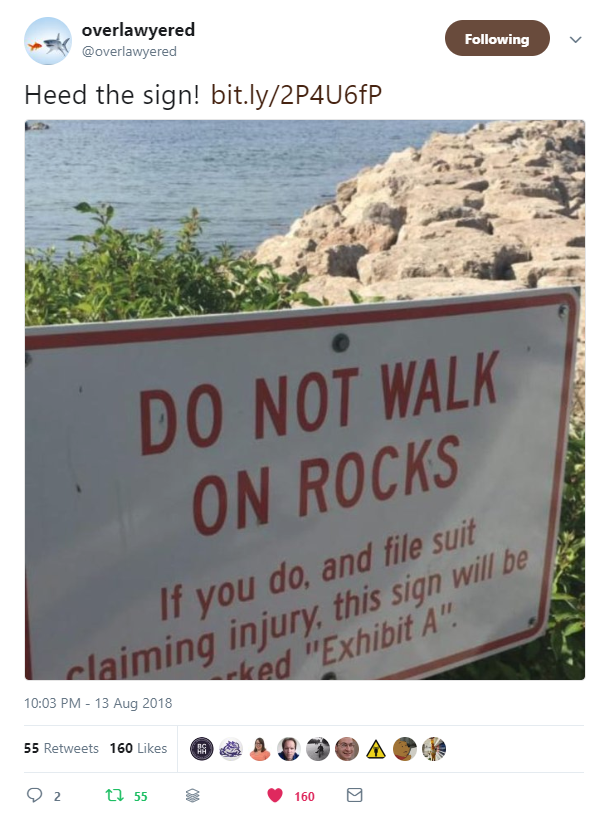
Britain’s Daily Mail has a pictorial feature on superfluous warning signs (via Free-Range Kids). Another peril to watch out for: “uneven surfaces” on beach sand.
{ 2 comments }
Chronicling the high cost of our legal system
Posts tagged as:
Britain’s Daily Mail has a pictorial feature on superfluous warning signs (via Free-Range Kids). Another peril to watch out for: “uneven surfaces” on beach sand.
{ 2 comments }
They might make you uneasy in new ways [Lowering the Bar, scroll]
{ 0 comments }
{ 3 comments }
Yes, it’s Bob Dorigo Jones’ annual Wacky Warning Label contest. Aside from the year’s winner, mentioned in the headline, other top entries included “Do not use if you cannot see clearly to read the information in the information booklet” (on a wart-removal product), “Always use this product with adult supervision” on a cereal bowl, and a bag of livestock castration rings cautioning, “For animal use only.” [AP/Times & Transcript (New Brunswick, Canada); Foundation for Fair Civil Justice] (more on wacky warnings)
Fox News contributes original reporting on some of the familiar Wacky Warning Labels made famous by Bob Dorigo Jones of Michigan Lawsuit Abuse Watch in an annual contest and book. It helps track down information, for example, regarding the origin of the warnings not to use a hair dryer while sleeping, not to heat up a cellphone in the microwave oven, not to use a curling iron in the shower, and not to swallow a fishing hook (the latter seems to have more to do with the potential toxicity of the lead in the hook than the hook aspect itself). The warning against the temptation to obtain the light necessary to check a fuel tank by flicking on a cigarette lighter recalls the Burma-Shave jingle of decades ago:
He lit a match/
To check gas tank/
That’s why/
They call him/
Skinless Frank.
Also noted in the article: a warning against using “birthday candles as earplugs ‘or for any other function that involves insertion into a body cavity’”.
{ 7 comments }
“If you bought a Bluetooth headset between June 30, 2002 and February 19, 2009, the settlement of a class action lawsuit may affect your rights.” And if you want to know why your instruction manuals are overwhelmed with worthless wacky warnings, the settlement of this class action lawsuit may explain why.
We’ve covered other ridiculous failure-to-warn-of-hearing-loss consumer-fraud lawsuits, but somehow missed this one filed by the Garcia Law Firm, which was eventually consolidated with twenty-six other lawsuits against Motorola, Plantronics, and GN Netcom (which makes “Jabra” headsets) alleging that the insufficiently advertised risk of hearing loss from turning the volume up too high on a Bluetooth headset was consumer fraud meriting damages, yadda yadda, because, without a wacky warning, people might not know that loud sounds can cause hearing loss.
The settlement is remarkable: the defendants are spending approximately $1.2 million to give notice of the settlement that offers $0 to the class. That’s, right $0. There’s a total $100,000 cy pres award to four charities selected by the plaintiffs, and the manufacturers agree to provide a wacky warning that “Exposure to loud noise from any source for extended periods of time may temporarily or permanently affect your hearing.” Only lawyers like warnings like this. Such warnings make the rest of us worse off; when people see so many warnings “crying ‘wolf,’” it inures them to meaningful warnings.
In return, the trial lawyers are going to ask for up to $850,000 in fees and costs—a remarkable infinite-percentage attorneys’ fee. Nine representative plaintiffs will ask the court for a total of $12,000 in “incentive” payments.
Walter and I often get inquiries on what readers can do when they get notice of a class-action settlement that benefits lawyers to the expense of consumers and businesses. The answer all too often is nothing: asking for exclusion doesn’t prevent the lawyers from cashing in; objecting without the help of an attorney will almost always be brushed off by the court; there is no financial incentive for an attorney to get involved, unless an objector wants to pay their tremendous fees–and there is certainly not an incentive for an objector to spend thousands of dollars to hire an attorney to object to a settlement like this.
The lawsuit is plainly meritless; but it costs Motorola and the other defendants a lot of money to have Kirkland & Ellis and Arnold & Porter litigators dealing with the case. Without a loser pays rule, it’s cheaper for the defendants to pay trial lawyers protection money to go away. Because no one has an incentive to object, the settlements get rubber-stamped, and the trial lawyers go on to file the next extortionate lawsuit. And we all pay higher prices as a result: the $2 million being spent on notice and plaintiffs’ attorneys doesn’t include the hundreds of thousands (and very likely over a million) spent by these companies on defense and in-house attorneys on three years of litigation to date.
In the Grand Theft Auto case, I was a class member, so could file an objection on behalf of myself. I don’t own a Bluetooth headset, so I can’t do that here. But the fairness hearing is in Los Angeles, I’m a member of the California bar and Central District of California bar, and I wouldn’t mind having an excuse to be in California on July 6.
I’m going to float a trial balloon here (and perhaps get my friends at Kirkland mad at me). If you are a reader, and you are one of the tens of millions of members of the class (and please read the notice to ensure that you are), and you find this settlement objectionable, I may be willing to represent you pro bono to file an objection similar to the one I filed in the Grand Theft Auto case, where I argued that the settlement was evidence that the case was meritless and should be dismissed, and in no event should the attorneys get paid off. Please understand that:
What say you, readers? Have you bought a Bluetooth headset, are you sick of extortionate lawsuits, and are you mad enough to go on the public record to say that you don’t think these attorneys should get $850,000?
This is not an April Fools’ joke; this is not an AEI-approved project. This is me, willing to spend my own spare time and money to do some real pro bono work in the original sense of pro bono publico if there is a disgruntled class member out there. (Of course, if there is a outpouring of readers who also want to donate money to defray expenses, let me know, and I’ll set up an Amazon or Paypal donation button.)
(Update: Thanks for the overwhelming response. I’ve selected five volunteers who will be the objectors, which will be more than enough. Stay tuned to Overlawyered for updates on the case.)
{ 28 comments }
Flickr user IWouldStay (Creative Commons, some rights reserved) snapped this one on a milk jug in the U.K.:
Related, earlier (chocolate milk).
{ 6 comments }
In comments last week, reader Richard Harrison recalled his favorite warning label, on a candle from Target.
{ 2 comments }
A sign at Edinburgh Airport will help you out. (Massie, Nov. 17).
{ 8 comments }
It was only natural for the professional organization of the civil defense bar, the Defense Research Institute, to include bulletproof disclaimer language when sponsoring a charity race for its own lawyer-members at its annual meeting, which took place earlier this month in New Orleans. As Robert Ambrogi points out, the waiver/disclaimer warned of the risks of high altitude (in a famously low-altitude city) and asked the signer to affirm that various horrific-sounding risks, such as those of terrorism, “contribute to my enjoyment and excitement and are a reason for my voluntary participation”.
{ 5 comments }
In the wacky warning genre, that one’s been around a while, but it can still get a discussion going (Wegman’s, What If via Megan McArdle).
{ 2 comments }
Readers turned it into more of a general funny-sign contest, but some of the entries hint at a legally driven tendency to overwarn. Among the most disturbing messages is the one on #53, “Toilets and urinals flushed with reclaimed water. Do not drink.” (Scroll to “As if you would anyway“).
P.S. From comments, Jane T.: “Yesterday I noticed that a commercial for a drug that is prescribed to reduce the size of enlarged prostates issued a warning (in the ad) that women should not take it for various reasons none of which were that women do not have prostates.”
{ 4 comments }
(Post bumped with 12:20 AM update adding coverage of state Labor Department’s suggestion for new warnings.)
Roller-coaster enthusiast and torts professor Bill Childs is stealing our thunder in his coverage of the recent Georgia Batman roller coaster decapitation of Asia LeeShawn Ferguson IV, so there’s no point in rewriting his excellent post instead of quoting it:
{ 19 comments }
Pulitzer-prize winning columnist Leonard Pitts Jr.:
Anna from Estonia mak[es] it a point to show visiting friends a sight they could never see in the old country. They laugh, they point, they whip out cameras and take pictures. Of the Everglades? No. Of Mount Rushmore or Lady Liberty? No.
Anna said they take pictures of the idiot signs. These she said, crack her friends up. “Caution: Coffee is hot.” Apparently, elsewhere in the world, you don’t need a sign to know this.
More on the deservedly infamous McDonald’s coffee case. Similar discussion: March 2.
Inconceivably beyond my frame of reference as an American: self-operated rides in a Denmark amusement park (as part of a larger travelogue on a very strange park, Bon Bon Land). Instructions are provided on signs: customers seat themselves, and the next person on line is supposed to press the appropriate button at the appropriate time to send a customer hurtling down a zip line.
It fascinates me how other cultures tolerate risk and reject idiot-proofing so much differently than the US. I wonder which way the causal arrow goes with the general litigiousness of American culture: are we litigious because we’re risk-averse, or are we risk-averse because we’re litigious? If the former, perhaps the European example actually reflects the moral hazard of social insurance. (Of course, other photos on the travelogue pages demonstrate other important differences between Denmark and the US.)
Related: Subcontinental Drift on zoos in Southeast Asia.
Update: Amusement-park-loving torts prof Bill Childs comments, which is appropriate, because the post was originally just going to be an email to Childs and a handful of other people before I realized there was no reason not to just expand it into a post.
{ 6 comments }
Slate’s Emily Bazelon doesn’t read the owners’ manual for her car, does something the owners’ manual explicitly says not to do—recline a seat in a moving car—and hurts herself. Bazelon blames… the automaker and NHTSA for not doing more to warn her, and serves as a mouthpiece for plaintiffs’ lawyers who specialize in such arguments, lionizing one who won a $59 million verdict against Toyota for his client’s own foolhardiness.
The NHTSA official Bazelon talks to points out that she’s taking one safety issue out of context; Bazelon pooh-poohs it because, after all, it happened to her and some other people, too! But Bazelon ignores that there are several dozen other dangerous problems addressed in the owners’ manual, many of which would kill or injure far more passengers than reclined drivers’ seats. One cannot just look at the idea of putting a single additional sticker on the dashboard: the car would have to be literally wallpapered with additional warnings to cover every warning of a matter at least as hazardous as car-seat reclining, at which point we’re back to the problem of owners ignoring warnings. Bazelon simply fails to address this reality.
But, hey, I’ll join Bazelon in telling you: don’t recline your car seat in a moving vehicle. (Long-time Overlawyered readers already know this from two separate posts.) Also, don’t drive with your windows open, your doors unlocked, or your seatbelt unfastened. Reattach your gas cap after filling the tank. Look behind you and ensure the path is clear before going in reverse. Keep your eyes on the road. Don’t pass a car in a no-pass zone or drive twice the speed-limit. Sit up straight, especially in a front seat with airbags. Don’t have loose heavy objects (including unbelted passengers) in the passenger compartment of the car. Don’t permit children to play with power windows; don’t leave children unattended in a car that is on; don’t leave the car on when you’re not in it; don’t try to jump into a moving vehicle. Don’t leave your shoes loose while driving. Be careful when shifting gears. Do not violently swerve an SUV, especially if there are unbelted passengers. Always be aware of the danger of pedal misapplication. Don’t fall asleep while driving. Don’t drive recklessly, and if you do, don’t leave the road. Use your parking brake when you park. Replace a tire after repeatedly patching it; don’t drive on bald tires in the rain; and replace your ten-year old tires before you have to drive on a spare. Make sure your floor mat isn’t interfering with the pedals. Don’t drive into the back of a truck at 60 mph without braking. Et cetera.
(And welcome, Instapundit readers. Check out our vast selection of automobile and personal responsibility articles.)
{ 50 comments }